
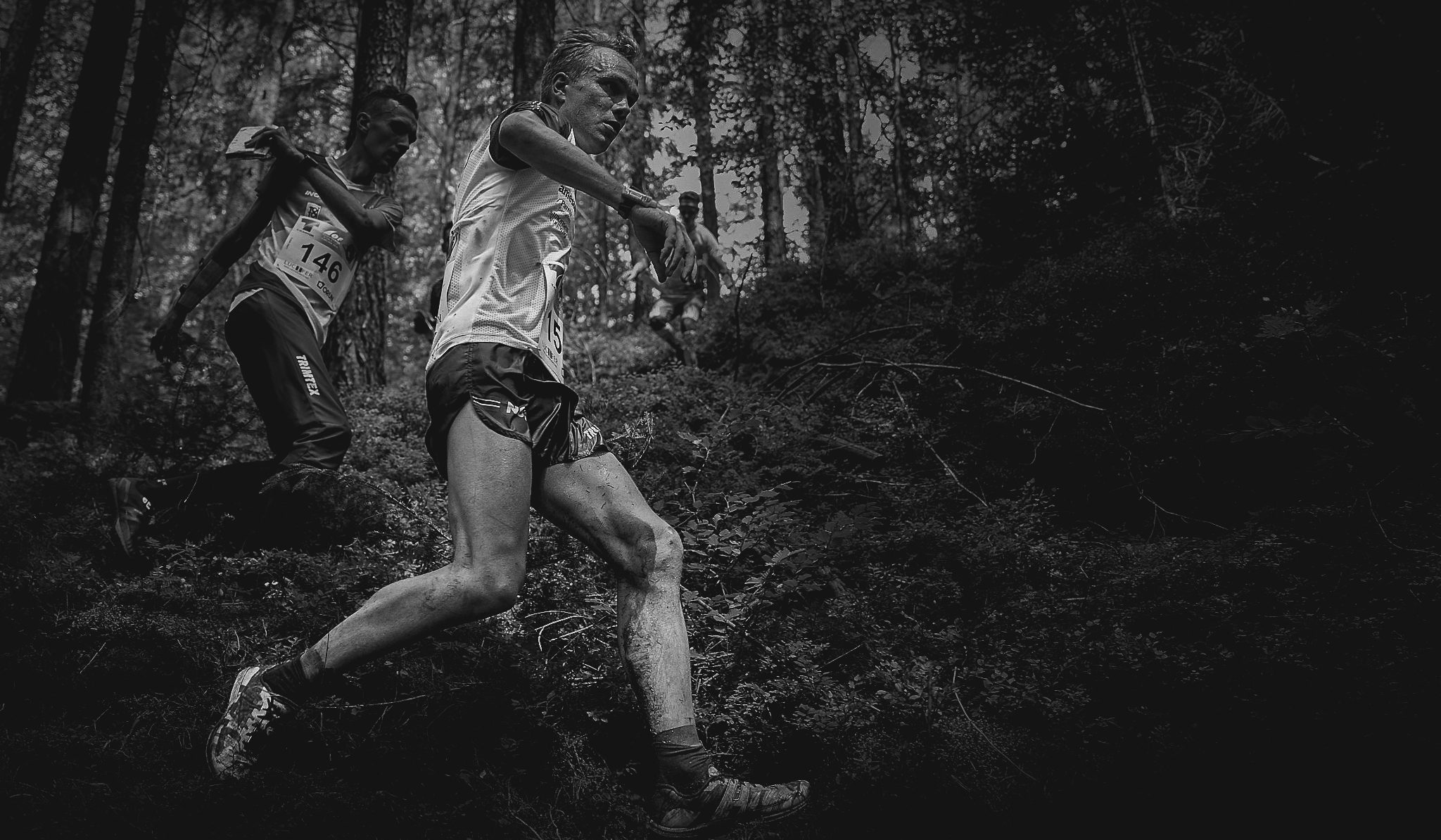
The marginal gains behind Kasper Fosser’s split shorts — and the science behind it
Elite orienteers have spent decades searching for marginal gains. A certain Svensk brother has been rumoured to run more than 30 hours per week. A certain Wingstedt used to do 10 high intensity sessions per week. Now heat suits are lined up at the crosstrainers at Actic in Falun. Bicarb, broccoli juice and suspicious amounts of caffeine pills are consumed like they were candy.
All in search of the marginal gain. .
Meanwhile, one variable has remained almost entirely untouched by modern sports science.
Pants.
At the World Cup long distance in the Czech Republic, the Faculty of Applied Kartography collected data on the equipment choices of the men’s field and cross-referenced them against finishing position.
What emerged was impossible to ignore.
The less fabric you wore, the better you performed.
The Less Is More Hypothesis
The athletes who chose shorts finished, on average, in 15.7th place. Those wearing three-quarter pants averaged 28.2nd. Athletes who committed to full-length trousers finished, on average, 38.6th.
That is a difference of almost 23 positions between exposed knees and complete leg coverage.
More importantly, the effect followed a remarkably clean progression:
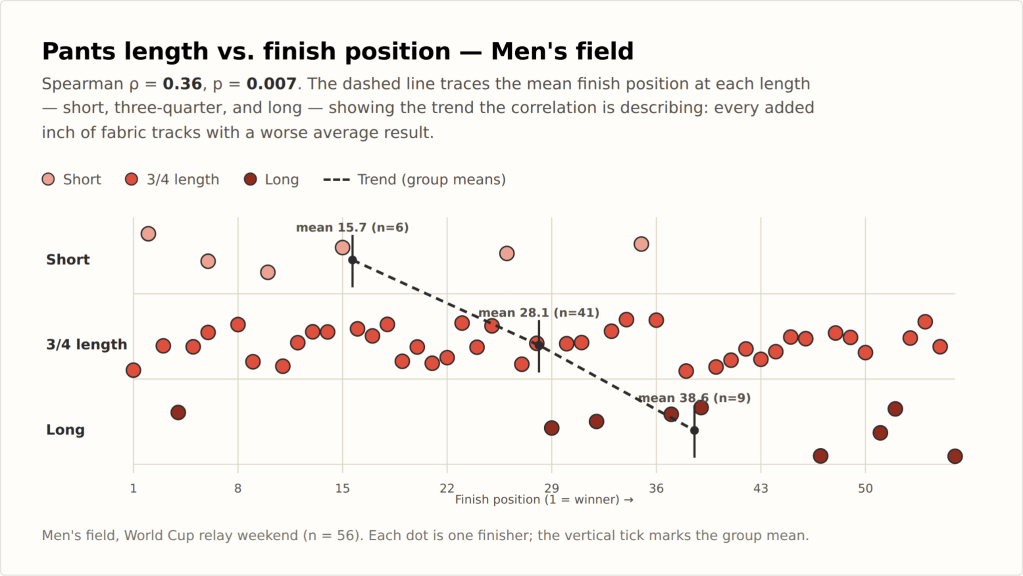
Four of the six athletes wearing shorts finished inside the top 15. Across the men’s field, trouser length correlated with finishing position at ρ = 0.36, with a p-value of 0.007.
In a more courageous scientific era, these numbers would already be printed on the labels of any pants covering less than 25% of your total body.
However, we live in an era where all serious orienteering journalists are affiliated with a federation sponsored by an industry whose wealth is built upon the endless consumption of nylon garments.
Some Scandinavian federations have even banned shorts in orienteering races.
We are not suggesting there is a pants lobby operating within international orienteering.
We are merely pointing out that, if there were, banning the primary alternative to pants would be remarkably convenient.
Although data is data, it remains useless without a mechanism.
And in the pursuit of truth we had to go deeper than we have ever gone in our research.
We were forced to commit journalism.
So we called a witness from the scene.
Some call him a pioneer. Some call him the all-knowing.
Some simply call him Kasper Fosser
(and a vast minority calls him Harlem)
The Protective wear Paradox
Running through a Czech forest with most of your legs exposed may seem counterintuitive.
Orienteering pants exist for a reason, and much of that reason has to do with thorns and nettles.
When asked why he nevertheless chooses shorts, Fosser offered a possible physiological mechanism:
“The pain from the thorns and nettles is so intense it distracts me from the pain of running.”
This had not been considered in our original model. We knew we were on the right track down this rabbit hole when we had to revise our hypotheses with immediate action.
The possibility that exposed skin improves performance through competitive pain displacement opens an entirely new avenue of research.
If external pain can successfully distract an athlete from internal pain, then generations of orienteers may have fundamentally misunderstood the role of nettles in endurance performance.
Rather than an obstacle, they may be an ergogenic aid. If you know what to wear.
Fosser, however, quickly provided a second and somewhat more conventional explanation.
“But mostly due to the extra heat you get from wearing long pants, especially in hot conditions.”
This was problematic, because unlike Competitive Pain Displacement, it made immediate physiological sense.
During prolonged exercise, the body produces large amounts of metabolic heat that must somehow be dissipated to the environment. Covering the legs in nylon provides an additional barrier to that process. Less fabric means less insulation and more skin directly exposed to the environment.
Suddenly, the progression in our data had acquired biological plausibility.
Full-length: 38.6th.
Three-quarter: 28.2nd.
Shorts: 15.7th.
Fosser: barely dressed, 2nd.
We were getting dangerously close to science.
The King of Skinmaxxing
In our dataset, “shorts” were defined as any trousers ending above the knee. Traditionally, this means trimmed nylon pants: enough fabric removed to liberate the kneecap, but not much more.
Fosser had gone considerably further.
His split shorts covered approximately 10 centimetres of his legs.
Within the group already associated with the best performance, Fosser therefore achieved both the lowest leg coverage and the highest finishing position.
Second place.
He had apparently taken our correlation and extrapolated beyond the dataset.
Not only was Kasper Fosser Skinmaxxing.
He was the King of Skinmaxxing.
But could competitive pain displacement and thermoregulation be the only reasons, or were there more secrets to uncover?
Progressive Trouser Loading
Pants are almost a part of us.
They are among the first things we put on in the morning and the last things we take off before going to bed. They allow us to participate in society. For most of our waking lives, they simply exist.
Perhaps this is why nobody noticed what Kasper Fosser had noticed.
Progressive Trouser Loading.
“I’ve also been shocked a few times from lifting my bag of wet orienteering clothes and feeling how heavy it is.”
The early memories Kasper is referencing raises another issue largely absent from the existing literature.
Pants do not necessarily maintain their starting weight.
A pair of full-length orienteering pants may enter a race relatively light.
Then the forest happens.
The athlete sweats. Vegetation is wet. Marshes appear. Streams are crossed. Rain may or may not be involved.
Fabric absorbs water.
Every gram absorbed then has to be carried for the remainder of the course.
Imagine someone standing at the start of a World Cup long distance and politely asking whether you would mind carrying an additional 200 grams of water around the course.
You would decline.
Put the same water inside your pants and nobody asks questions.
This creates what FAK researchers have provisionally termed Progressive Trouser Loading: the possibility that the energetic penalty of trousers increases throughout the race, precisely as the athlete becomes less interested in carrying additional mass.
Shorts offer an elegant solution.
There simply isn’t much trouser available to become wet.
The First Human Trial
The evidence remains anecdotal, but Fosser had already begun conducting his own field experiments long before the Faculty of Applied Kartography was even established as an institution. .
“I tried to run in shorts a few times in 2024 and felt like I could manage a few scratches now and then.”
The intervention was tolerated.
The scratches were manageable.
And by the Czech World Cup, the shorts had made it all the way to international long-distance competition.
The result: second place.
We believe that Kasper’s dress code was not coincidental.
Location, Location, Location
There was, however, one problem with the Less Is More Hypothesis.
If performance simply increased as total fabric decreased, the effect should not care where that fabric was removed.
So we looked above the waist.
But singlets failed us.
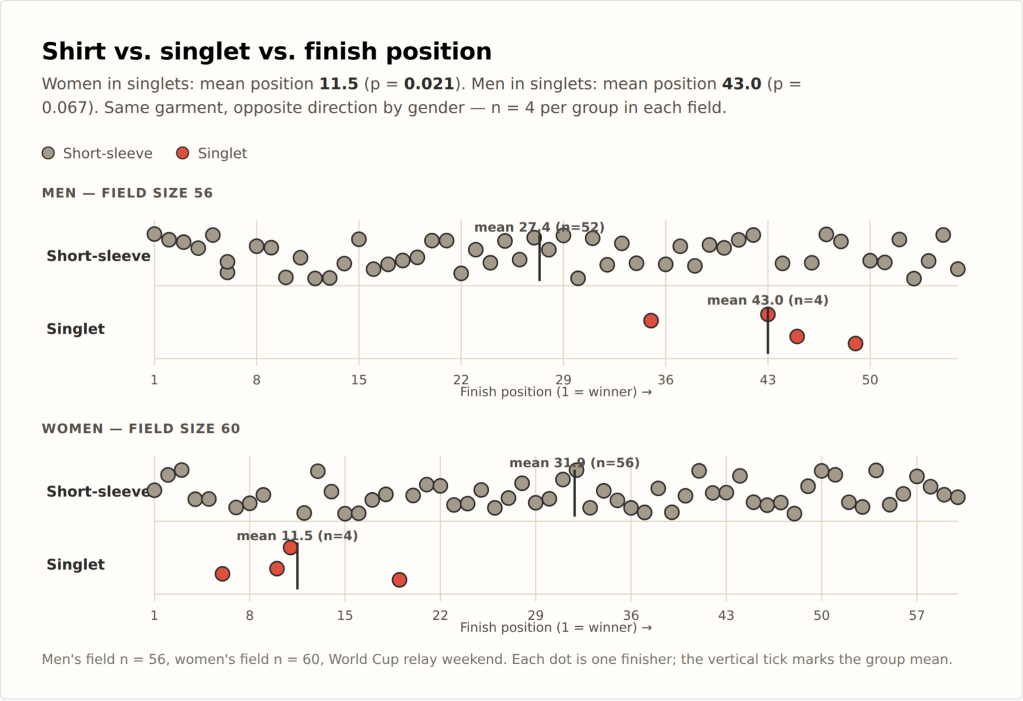
Among men, singlets appeared to be associated with worse performance. Among women, the relationship went in the opposite direction. These sex-specific differences are fascinating, but we have chosen not to comment further in order to avoid being educated by the public.
The important conclusion was elsewhere.
It wasn’t simply how much fabric you wore. It was where you wore it.
The Less Is More Hypothesis had become anatomically specific.
Skinmaxxing, apparently, requires precision.
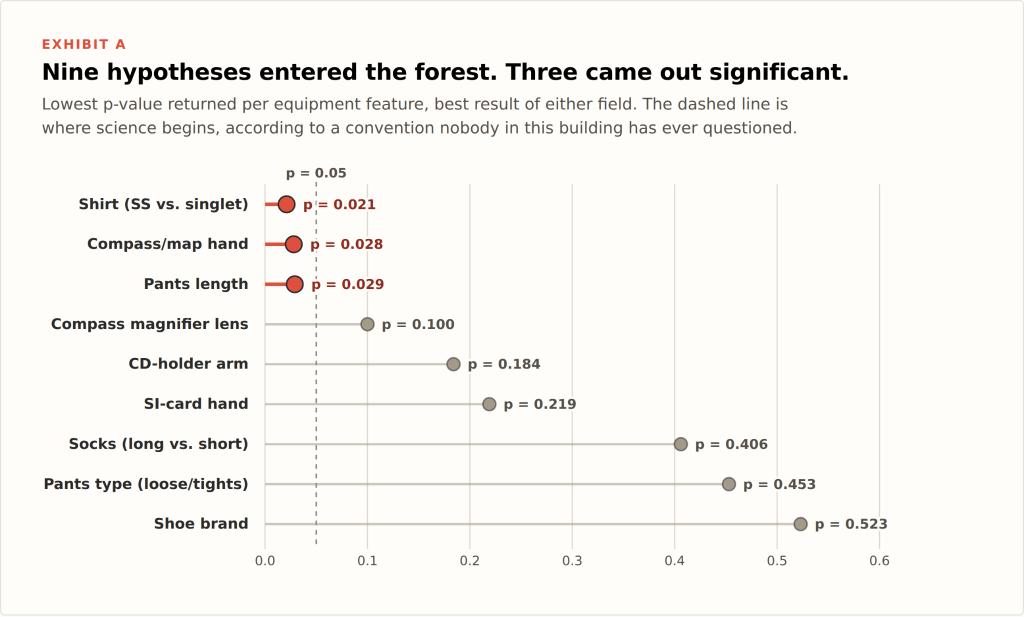
What doesn’t require precision is for example sock length, pants type or even shoe brand, at least not in Czech terrain.
Correlation, Causation and Other Inconveniences
There is, admittedly, one problem.
Perhaps shorts do not make people fast.
Perhaps fast people simply wear shorts.
The six athletes in our short-pants group may differ from the rest of the field in ways not adequately captured by trouser length. Confidence alone could be a confounding variable. An athlete willing to stand on a World Cup start line, look at a Czech forest and conclude that a few centimetres of fabric around the upper thigh constitute sufficient protection may already possess psychological characteristics associated with high performance.
We chose not to investigate this matter any further than necessary as it might have affected our narrative.
The Fosser Protocol – for those willing to follow
Research is an important part of learning. But occasionally, it misses the whole point.
Perhaps the most interesting finding did not come from our spreadsheet at all.
Fosser does not appear to regard split shorts as everyday equipment.
Asked whether he would wear them again, his answer suggested something closer to deliberate periodization.
“I probably would if it was a World Cup or WOC race. I like to save the shorts for special occasions.”
This changes things. Maybe everything.
If split shorts were simply more comfortable, there would be little reason to reserve them for major championships. Instead, Fosser appears to deploy maximal skin exposure selectively, when performance matters most.
Training in trousers preserves the skin, one of the largest and, according to several sources, more important organs of the human body.
But health and performance are not always aligned.
Championship racing in split shorts maximizes thermoregulation, minimizes Progressive Trouser Loading and unlocks the potential benefits of Competitive Pain Displacement.
The Fosser Protocol can therefore be summarized:
Protect the legs during preparation.
Expose the quadriceps when medals are at stake.
For decades, endurance athletes have understood the benefits of manipulating altitude between training and competition. Applied Kartography now proposes the same principle for trouser coverage.
Train high. Race low.


Leave a Reply